- Home
- About IEAC
- Accreditation
- University Accreditation
- College Accreditation
- Online Institution Accreditation
- School Accreditation
- University Recruitment Agency Accreditation
- Programmatic Accreditation
- Teacher/ Lecturer Accreditation
- Religious Institutes Accreditation
- Affiliate Accreditation
- Research Accreditation Candidacy Accreditation
- IEAC Membership
- Institutions Accredited
- Accreditation Process
- Contact Us Webinar Apply Now
Blog
The Quality Blueprint: How Rigorous Evaluation Transforms Classroom Outcomes?
Lorem ipsum dolor sit amet, consectetur adipiscing elit, sed do eiusmod tempor incididunt ut labore et dolore magna aliqua. Quis ipsum suspendisse ultrices gravida. Risus commodo viverra maecenas accumsan lacus vel facilisis.

The Quality Blueprint: How Rigorous Evaluation Transforms Classroom Outcomes?
Every school community shares a fundamental mission: to help students succeed and ensure they leave the classroom prepared for the future. Yet, measuring true success goes far beyond standardized test scores or modern school facilities. The real difference lies in the invisible frameworks supporting daily education. For academic leaders navigating a progressively connected global environment, maintaining exceptional educational standards requires a structured approach.
When an institution moves past interior reviews and aligns with internationally benchmarked quality standards, the impact on student achievement is profound. Understanding the structural shifts that occur when an institution prioritizes comprehensive evaluation shows exactly how these rigorous standards transform daily learning.
Why Learning Outcomes Need Attention?
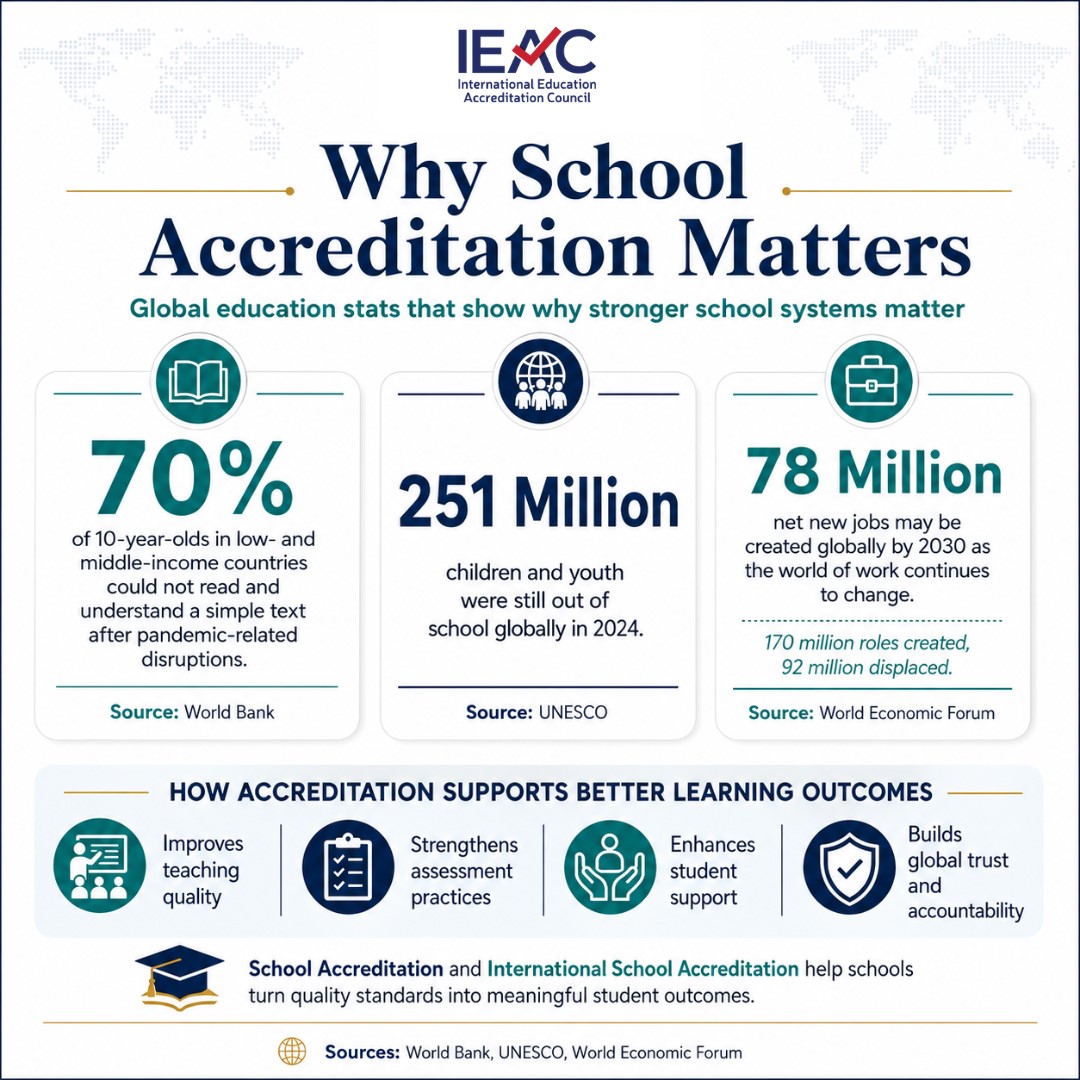
Across numerous countries, access to education has improved, but learning gaps still remain. The World Bank reported that around 70% of 10-year-olds in low- and middle-income countries could not read and understand a simple text after pandemic-related disruptions. UNESCO also reported in 2024 that 251 million children and youth were still out of school globally, showing that access and quality remain major education challenges.
These numbers remind us that being enrolled in school is not enough. Students must actually learn, grow, and develop the skills they need for life. Accredited schools are better positioned to focus on this because accreditation encourages institutions to look closely at the full learning experience, not just exam scores.
The Structural Shifts
Understanding the structural shifts that occur when an institution prioritizes comprehensive evaluation shows exactly how these rigorous standards transform daily learning.
1. Transforming Teaching from Isolated Activity into Shared Excellence
In many traditional settings, teaching can inadvertently happen in isolation. An educator enters their classroom, closes the door, and delivers a lesson plan that may not have been evaluated by their peers.
Pursuing external verification changes this dynamic entirely. Partnering with a recognized University Accreditation Agency or international body introduces structured, peer-reviewed evaluation systems. This structural shift provides educators with reliable, data-driven feedback on their instructional methods. By establishing clear teaching standards, schools ensure every classroom benefit from proven teaching techniques. This consistency helps prevent students from falling behind due to uneven teaching quality.
2. Aligning Local Curriculum with Global Job Market Demands
A dynamic school curriculum must evolve alongside the modern workforce. Globally, the reliance on advanced, specialized talent continues to grow rapidly. Recent projections indicate that high-skill employment opportunities worldwide are expanding at a steady rate of over 1.5% annually. To prepare students for this landscape, institutions must ensure their programs meet rigorous standards of relevance and depth.
Achieving comprehensive School Accreditation guarantees that a school's curriculum is regularly updated and aligned with modern industry expectations. This ensures students do not just memorize facts, but build the practical, cross-cultural problem-solving skills needed in today's workforce.
3. Developing an On-Going Culture of Institutional Improvement
True educational excellence is never a static achievement or a one-time compliance checklist. Instead, it requires a continuous cycle of self-reflection, modification, and structural development. When an institution earns formal verification, it commits to an ongoing development model. School leaders regularly assess their program design, student support systems, and facility safety against international baselines. This proactive approach helps schools address resource needs or shifting student requirements before they impact classroom learning.
4. Securing Clear Pathways for Academic Mobility
In our interconnected world, a student's educational journey rarely stays within a single city or country. Families frequently relocate for career changes, and ambitious graduates routinely seek out international universities. Without a globally recognized mark of quality, transferring credits across borders can be a frustrating, complex process.
Prioritizing International School Accreditation provides immediate verification of academic quality. It ensures that an institution's transcripts, grading metrics, and diploma values are easily understood by registrar offices and corporate recruiters worldwide. This foundation allows students to transition smoothly between international systems without losing their hard-earned progress.
Global Trust Becomes Easier to Build
For schools serving international families, expatriate communities, mobile learners, or globally minded parents, credibility matters deeply. International School Accreditation can help schools communicate quality beyond local boundaries. It shows that the institution is willing to be reviewed, guided, and improved through external standards.
This can support parent confidence, staff recruitment, school partnerships, and long-term reputation. It also helps schools position themselves in a competitive education landscape where families compare institutions carefully before making decisions.
Final Thoughts
Accreditation does not automatically create better learning outcomes. What creates better outcomes is the improvement culture that accreditation encourages. School Accreditation helps schools ask better questions. It pushes leaders to strengthen systems. It supports teachers. It improves assessment. It places student growth at the centre of decision-making.
For schools that want to move from promise to proof, accreditation can be a meaningful step forward. In the end, better learning outcomes come from schools that are willing to look honestly at themselves, improve continuously, and place every learner’s success at the heart of their mission.
FAQs
1. What is School Accreditation?
School Accreditation is a quality review process that helps schools evaluate their teaching, leadership, curriculum, assessment, student support, and improvement systems against recognised standards.
2. How does accreditation improve learning outcomes?
Accreditation encourages schools to strengthen teaching quality, use assessment more effectively, support students better, and make decisions based on evidence rather than assumptions.
3. Why is International School Accreditation important?
International School Accreditation helps schools build credibility with global families, students, educators, and partners by showing that the institution follows recognised quality standards.
4. Does accreditation only benefit school management?
No. Accreditation benefits the entire school community. Students receive better support, teachers gain clearer direction, parents build greater trust, and leaders improve long-term planning.
5. Can accreditation help teachers improve?
Yes. Accreditation often encourages professional development, classroom review, better lesson planning, and continuous teacher support, all of which can improve student learning.
Beyond the Checklist: How Digital Trust Is Redefining Online Institution Accreditation?

7th October 2026

29th September 2026

25th September 2026

17th September 2026

8th September 2026

31st August 2026