- Home
- About IEAC
- Accreditation
- University Accreditation
- College Accreditation
- Online Institution Accreditation
- School Accreditation
- University Recruitment Agency Accreditation
- Programmatic Accreditation
- Teacher/ Lecturer Accreditation
- Religious Institutes Accreditation
- Affiliate Accreditation
- Research Accreditation Candidacy Accreditation
- IEAC Membership
- Institutions Accredited
- Accreditation Process
- Contact Us Webinar Apply Now
Blog
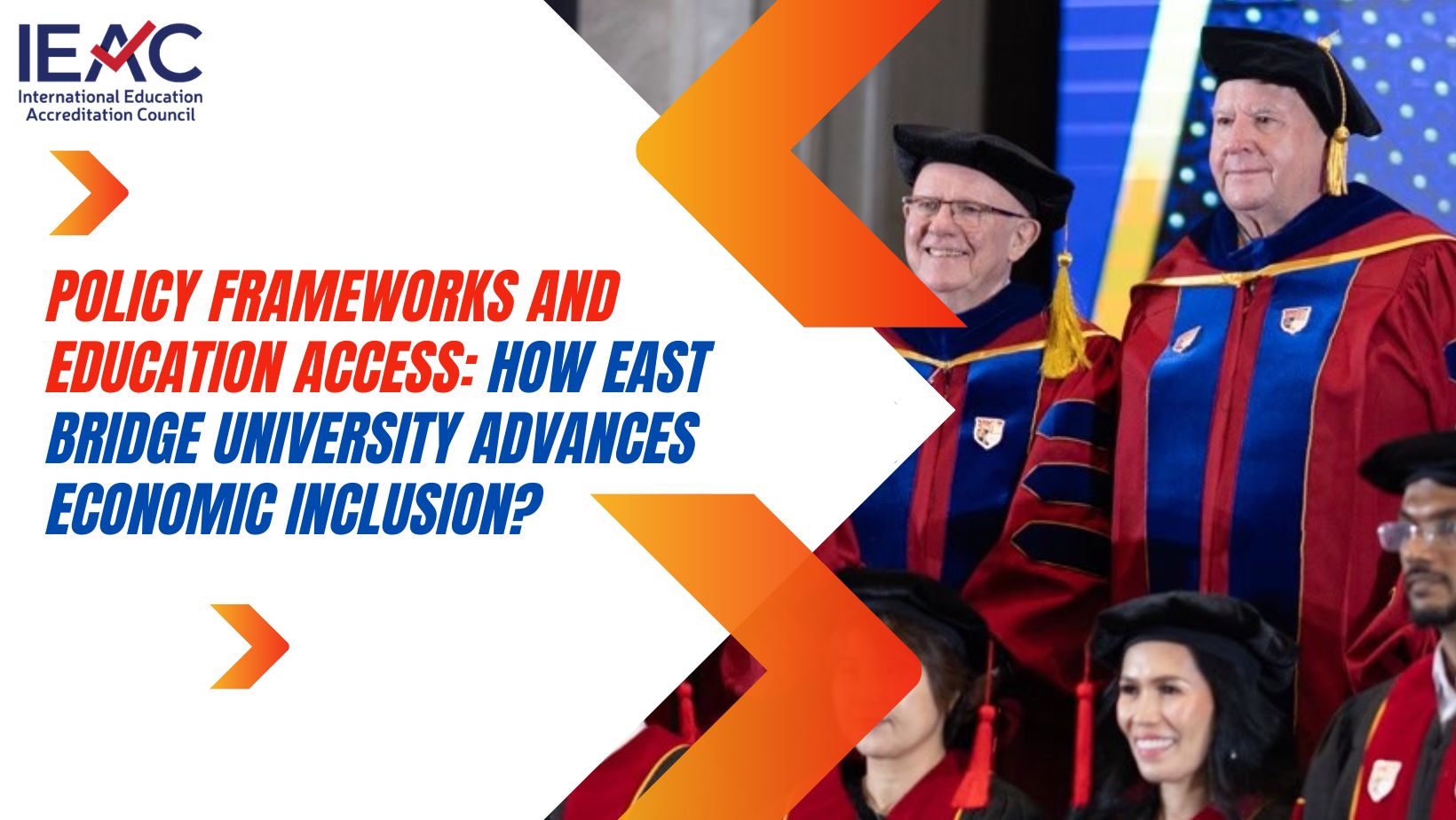
Policy Frameworks and Education Access: How East Bridge University Advances Economic Inclusion?
Lorem ipsum dolor sit amet, consectetur adipiscing elit, sed do eiusmod tempor incididunt ut labore et dolore magna aliqua. Quis ipsum suspendisse ultrices gravida. Risus commodo viverra maecenas accumsan lacus vel facilisis.
Policy Frameworks and Education Access: How East Bridge University Advances Economic Inclusion?
In this 21st century digital landscape, as the world has become more interconnected than ever, access to higher education still remains somewhat uneven across several regions and communities. International educational bodies, in alignment with the United Nations Sustainable Development Goals, are actively working towards recognising and eliminating the structural barriers that learners may face across the globe.
East Bridge University, being an accredited global higher educational institution, is actively working towards creating an inclusive, accessible, and affordable learning ecosystem that caters to students worldwide, especially from less-priveledged communities. As a part of their ongoing efforts to promote the United Nations Sustainable Development Goals, the University has developed a series of structured policy frameworks, institutionalising their aim of expanding educational access and professional advancement that will eventually lead to greater economic mobility.
Aligning Institutional Vision with SDG 1: No Poverty
East Bridge University has recognised one important fact that the goal of SDG 1: No Poverty is not limited to providing economic assistance programs. Rather, it is just a stepping stone for a larger global outcome. The real aim of promoting UN SDG 1 is to create an educational ecosystem where learners from various economic, regional and cultural backgrounds can come together and thrive in their educational journeys.
For students from marginalised communities, access alone is not enough. Hence, the University focuses on creating long-term solutions that strengthen access to opportunities that include education, skills development, and professional advancement.
Through its academic programs and governance frameworks, the institution aims to support learners who may otherwise encounter barriers to higher education. In doing so, it seeks to contribute to the wider objective of strengthening education as a pathway to economic mobility.
Policy Frameworks Supporting Accessible Education
Recognising education as a powerful driver of economic mobility, East Bridge University has developed institutional policies designed to alleviate educational barriers for students globally. For students and working professionals with the need to balance family and financial responsibilities, the challenge is not a lack of motivation, but the practical realities of accessing higher education. Tuition structures, rigid payment timelines, or the absence of recognition for professional experience often hinder their path to higher education.
Recognising this glaring reality, East Bridge University has institutionalised policies that address financial accessibility, flexible tuition structures, scholarship programs, instalment-based payment models, and recognition of prior learning for working professionals. These frameworks focus on improving financial accessibility and academic flexibility for diverse groups of learners.
Key measures include:
- Flexible tuition structures that allow learners to manage education costs more gradually
- Scholarship frameworks that intend to support individuals from financially constrained backgrounds
- Instalment-based payment models that reduce the burden of large upfront tuition payments
- Recognition of Prior Learning (RPL) mechanisms that acknowledge professional experience gained outside traditional academic settings
Together, these policies reflect an understanding that education systems must respond to the realities of modern learners. Many individuals accumulate valuable knowledge through professional experience, yet require pathways that allow this experience to translate into recognised academic progress.
Supporting Mid-Career Professionals
Through EBU’s policy frameworks, it supports professionals seeking to return to education later in their careers. Many individuals accumulate substantial expertise through work experience but encounter difficulty translating that experience into a formal academic credential.
Recognition of prior learning allows EBU to acknowledge professional knowledge and integrate it into academic pathways. For mid-career professionals, such frameworks can shorten the time required to complete programs while maintaining the academic integrity of their degrees.
From Policy to Practice: Educational Initiatives and Partnerships
To take another step forward, East Bridge University actively works towards translating its policy frameworks into practical actions. The University has undertaken a range of academic and community-oriented initiatives aligning with its aim to promote the United Nations Sustainable Development Goals.
East Bridge University has academic partnerships with universities in Vietnam, where they have explored discussions about flexible learning pathways such as dual degree models, credit transfer mechanisms, and recognition of micro-learning.
Alongside academic partnerships, the University’s engagement with community-based organisations highlights another dimension of its work. In Mumbai, India, collaboration with Ashadeep Association focused on supporting teachers working with children from economically disadvantaged backgrounds.
In alignment with the University’s effort to reduce financial barriers in education, EBU also participates in outreach and social support initiatives. This is evident from their activities in Thailand, that includes support for children with disabilities during Children’s Day and humanitarian assistance during flood relief efforts. Similarly, interactions with school communities, such as the visit to Vivekananda Vidyapith in Kolkata, demonstrate the role of early educational engagement in shaping long-term aspirations.
These efforts highlight that East Bridge University recognises that an important aspect of creating accessible education is addressing the environments in which learners thrive and grow. Through the varied initiatives, the University has highlighted a common thread that inclusive education is not created by a single intervention, but through a combination of academic access, community engagement, and sustained dialogue. By connecting institutional policy with real-world contexts, East Bridge University’s approach reflects an effort to translate the principles of SDG 1 into practical, education-led outcomes.
Transparency Through Policy Access
An important feature of EBU’s approach is the public availability of its sustainability and inclusion policies. By making these frameworks accessible through its SDG Policy Repository, the institution enables students, educators, and stakeholders to examine how its governance structures align with broader development goals.
Access to policy documentation also encourages transparency in how institutions interpret and implement global frameworks such as the Sustainable Development Goals.
Conclusion
Institutional policies that address financial accessibility and inclusive learning pathways can play an important role in expanding educational opportunity. For universities, aligning governance frameworks with global development goals can also help ensure that access to education remains responsive to the needs of diverse learners.
At East Bridge University, policies connected to SDG 1: No Poverty, including scholarship mechanisms and inclusion frameworks, are made publicly accessible through the institution’s SDG Policy Repository.
Through structured governance and inclusive academic models, the university continues to position education as a long-term instrument of economic empowerment.
From Local Excellence to Global Trust: A School Leader's Guide to Primary School Accreditation

25th September 2026
17th September 2026

8th September 2026

31st August 2026

26th August 2026

20th August 2026