- Home
- About IEAC
- Accreditation
- University Accreditation
- College Accreditation
- Online Institution Accreditation
- School Accreditation
- University Recruitment Agency Accreditation
- Programmatic Accreditation
- Teacher/ Lecturer Accreditation
- Religious Institutes Accreditation
- Affiliate Accreditation
- Research Accreditation Candidacy Accreditation
- IEAC Membership
- Institutions Accredited
- Accreditation Process
- Contact Us Webinar Apply Now
Blog
Education Program Evaluation Process: A Step-by-Step Guide
Lorem ipsum dolor sit amet, consectetur adipiscing elit, sed do eiusmod tempor incididunt ut labore et dolore magna aliqua. Quis ipsum suspendisse ultrices gravida. Risus commodo viverra maecenas accumsan lacus vel facilisis.
Education Program Evaluation Process: A Step-by-Step Guide
What separates a programme that looks good on paper from one that genuinely transforms learners?
The answer, more often than not, comes down to evaluation, and most institutions are not doing it as thoroughly as they think.
Whether you are a school leader, a curriculum designer, a policymaker, or an accreditation professional, understanding how a structured education program evaluation works is no longer optional. It is the difference between institutions that grow with confidence and those that stagnate without ever knowing why.
Let's explore the entire process step by step, without the jargon.
What Is Education Program Evaluation and Why Should You Care?
At its core, education program evaluation is a systematic process of collecting, analysing, and interpreting data to determine whether an educational programme is achieving what it set out to achieve.
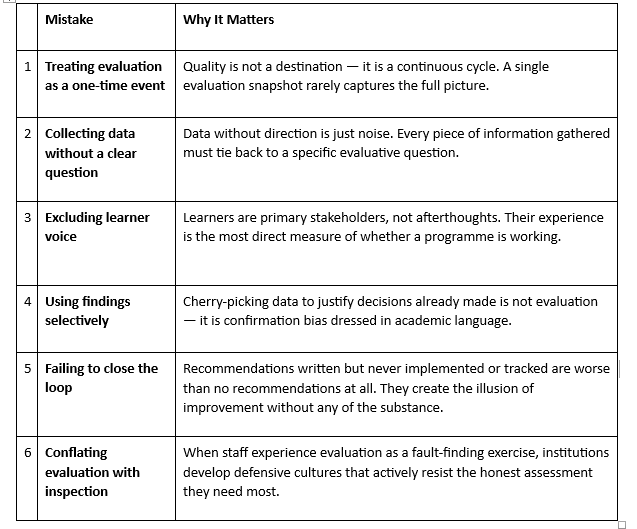
But here is where many people get it wrong, evaluation is not the same as inspection. It is not a fault-finding exercise.
It is, in fact, a learning tool for institutions. Done well, it answers questions like:
- Are learners actually acquiring the skills and knowledge the programme promises?
- Is the curriculum aligned with current industry and societal needs?
- Are teaching methods effective for the intended audience?
- Is the programme delivering value relative to the resources it consumes?
These are not administrative questions. They are strategic ones and the answers shape everything from staffing to curriculum redesign to institutional reputation.
The 5 Core Stages of an Education Program Evaluation
While frameworks vary across countries and accreditation bodies, most rigorous evaluation processes follow five foundational stages.
Stage 1: Defining the Purpose and Scope
Before any data is collected, evaluators must answer one critical question: Why are we evaluating this programme?
The purpose could be:
- Accountability: Demonstrating to stakeholders that the programme meets required standards
- Programme improvement: Identifying gaps and opportunities to enhance quality
- Decision-making: Determining whether to continue, modify, or discontinue a programme
- Accreditation: Satisfying external standards set by a recognised body
The scope defines what will be evaluated, whether that is the full curriculum, specific modules, teaching delivery, student outcomes, or all of the above. Getting this stage wrong is the single most common reason evaluations fail to produce useful results.
Stage 2: Selecting an Evaluation Framework
No evaluation should proceed without a clear methodological framework. Some of the most widely used models globally include:
- Kirkpatrick's Four-Level Model: Reaction, Learning, Behaviour, Results (widely used in professional and corporate education settings)
- CIPP Model (Context, Input, Process, Product): Developed by Daniel Stufflebeam; particularly popular in government and large institutional evaluations
- Tyler's Objectives-Based Model: Focuses on how well programme objectives are being met
- Logic Model: Maps the relationship between programme inputs, activities, outputs, and outcomes
The choice of framework depends on the programme type, the evaluation audience, and the available resources.
Stage 3: Data Collection (Quantitative and Qualitative)
This is where evaluation becomes hands-on. Strong data collection draws from multiple sources to build an accurate, unbiased picture.
Quantitative data sources include:
- Learner assessment scores and progression rates
- Completion and dropout rates
- Employment or placement outcomes post-programme
- Learner-to-teacher ratios
- Programme completion timelines vs benchmarks
Qualitative data sources include:
- Structured surveys and feedback forms from learners and faculty
- Focus groups with students, parents, and employers
- Classroom observations and teaching audits
- Interviews with programme coordinators and academic leads
- Review of curriculum documentation and learning materials
The strongest evaluations triangulate data, meaning they cross-reference multiple sources before drawing any conclusions. One metric in isolation rarely tells the full story.
Stage 4: Analysis and Interpretation
Raw data means nothing without skilled interpretation. At this stage, evaluators look for patterns, anomalies, and correlations. They compare findings against:
- The programme's own stated objectives
- National or international benchmarks
- Previous evaluation cycles (where applicable)
- Accreditation criteria from relevant bodies
This is also where educational standards evaluation becomes particularly important. Institutions operating globally must ensure their programmes are not just internally coherent, they must hold up against recognised international standards. Bodies such as the International Education Accreditation Council (IEAC) provide those external benchmarks, giving institutions and their stakeholders confidence that quality is not just claimed but independently verified.
Interpretation must be objective. One of the most common pitfalls at this stage is confirmation bias, where evaluators unconsciously focus on data that supports a predetermined conclusion. Credible evaluations build in safeguards against this, often by involving external reviewers.
Stage 5: Reporting, Recommendations, and Action Planning
Evaluation without action is just a document. A well-structured evaluation report should:
- Clearly present findings without distortion
- Distinguish between strengths and areas requiring improvement
- Offer specific, actionable recommendations, not vague observations
- Include a realistic implementation timeline
- Identify who is responsible for each recommended action
The report should be accessible to multiple audiences, from academic boards and institutional leadership to teaching staff and, where appropriate, learners themselves.
Critically, institutions should schedule a follow-up review at a defined point after implementation to assess whether the recommended changes have produced the intended results. Without this, the evaluation cycle remains incomplete.
What Role Does Accreditation Play in Programme Evaluation?
Accreditation and evaluation are closely related but not identical.
- “Accreditation” is an external validation process, that confirms that an institution or programme meets a defined set of standards set by a recognised authority.
- “Evaluation” is an internal (or externally commissioned) analytical process that examines how and how well a programme functions.
Both are necessary. And when done together, they create an institutional culture of genuine quality assurance.
For institutions seeking international recognition, aligning their internal evaluation processes with the criteria used by accreditation bodies is not just a smart strategy, it is what makes accreditation meaningful rather than ceremonial.
Why Global Standards Are Reshaping How Institutions Evaluate Programmes?
Education is increasingly borderless. Learners from Asia are studying European curricula. Professionals in Africa hold certifications issued in the UK. Teachers trained in India work in the Middle East and Southeast Asia.
This global mobility means institutions can no longer evaluate their programmes solely against local benchmarks. The question is no longer just "Are we meeting our own standards?" It is "Do our standards hold up anywhere in the world?"
A rigorous educational standards evaluation framework helps institutions answer that question with confidence, not defensiveness.
Internationally recognised accreditation bodies play a critical role here by establishing clear, transparent, and consistently applied criteria that transcend geography. Institutions that align with these frameworks are not just earning credentials, they are contributing to the global elevation of educational quality.
The Bottom Line
A meaningful education program evaluation is not a bureaucratic exercise, it is an institutional commitment to honesty, growth, and the learners who place their trust in you.
The institutions that take this process seriously are the ones that consistently produce graduates who are genuinely prepared for the world they are stepping into. And in an era where credential quality is scrutinised more than ever, by employers, by governments, and by learners themselves, that commitment to rigorous educational standards evaluation is what separates enduring institutions from forgettable ones.
The question worth asking is not whether your programmes should be evaluated. It is how well you are doing it.
Frequently Asked Questions (FAQs)
1. What is an education program evaluation?
Education program evaluation is a systematic process of analysing whether a programme meets its objectives, delivers outcomes, and maintains quality standards.
2. Why is the evaluation of educational standards important?
It ensures programmes meet recognised benchmarks, maintain quality, and remain relevant in a global education landscape.
3. What are the key stages of programme evaluation?
The process includes defining scope, selecting a framework, data collection, analysis, and reporting with actionable recommendations.
4. How is evaluation different from accreditation?
Evaluation is an internal analysis of programme effectiveness, while accreditation is external validation that confirms quality standards are met.
5. What are common mistakes in programme evaluation?
Mistakes include treating evaluation as a one-time activity, ignoring learner feedback, collecting irrelevant data, and failing to implement recommendations.
From Local Excellence to Global Trust: A School Leader's Guide to Primary School Accreditation

25th September 2026

17th September 2026

8th September 2026

31st August 2026

26th August 2026

20th August 2026